Journaling After Trauma: A Safe Way to Begin Processing

Journaling after trauma is one of the gentlest ways to begin making sense of what happened — not by forcing yourself to relive it, but by giving your mind a safe place to land. Research shows that expressive writing about difficult experiences reduces intrusive thoughts, lowers cortisol levels, and helps the brain organize fragmented memories into a coherent narrative.
If you’ve been through something that shattered your sense of safety or control, you don’t need to have the right words. You don’t need to write beautifully or even write about the event itself. You just need a page, a pen, and permission to start wherever you are. What matters is giving your thoughts a direction — and journaling for emotional clarity begins the moment you pick up the pen.
What Trauma Does to Your Thinking
Trauma doesn’t just live in your memory — it rewires how you think. The mind after trauma often cycles between hypervigilance (scanning for danger) and numbness (shutting down to protect itself). Thoughts become fragmented. You might feel like you can’t focus, can’t plan, can’t imagine a future. Your inner dialogue may loop between self-blame, fear, and confusion.
This is where writing becomes powerful. When you journal, you externalize those fragmented thoughts. Instead of circling endlessly inside your head, the words land on paper — visible, contained, and separate from you. This small act of externalizing creates distance. And distance is the beginning of clarity.
Studies on how journaling rewires your brain show that writing activates the prefrontal cortex — the part of the brain responsible for rational thought, planning, and emotional regulation. Trauma pushes the brain into survival mode. Writing pulls it back toward processing mode.
Why Journaling After Trauma Is Different
This is not regular journaling. You’re not writing morning pages or listing ten things you’re grateful for. Journaling after trauma requires boundaries, gentleness, and a structure that makes you feel safe rather than exposed.
The goal isn’t to “process everything” in one sitting. The goal is to show up, even for five minutes, and give yourself a small container for what’s happening inside.
Three important rules to keep yourself safe:
- Set a timer. Write for 10 to 15 minutes, then stop. Overwriting can be retraumatizing. You don’t need hours — you need containment.
- You don’t have to write about the trauma itself. Write about how you feel today. Write about what you need. Write about what felt manageable this morning. The event will surface when you’re ready — don’t force it.
- Ground yourself before and after. Take three slow breaths before you start. When you finish, close the journal, put your feet flat on the floor, and notice something in the room. This signals to your nervous system that you’re safe.
Structuring Your Thoughts When Everything Feels Chaotic
One of the hardest parts of healing from trauma is the mental chaos — the sense that your thoughts have no direction, your days have no structure, and your future has no shape. A structured journal gives you a framework to organize what feels unorganizable.
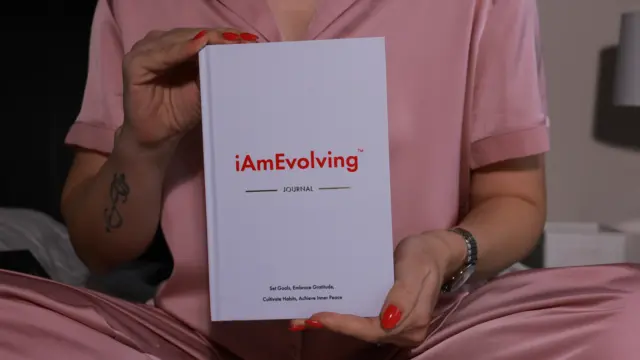
The iAmEvolving Journal is built around four daily sections, and each one takes on a specific role during trauma recovery. Together, they give you a complete daily practice — not random writing, but intentional, focused work that moves you forward even when it doesn’t feel that way.
Goals — Choosing Direction When You’ve Lost It
After trauma, your mind is stuck in the pain of where you are. Goals pull you toward where you want to be. Not someday, abstract goals — a clear picture of the opposite of your current situation, written as if it’s already true.
Ask yourself: what is the opposite of where I am right now? If you feel broken, the opposite is wholeness. If you feel lost, the opposite is clarity. If you feel unsafe, the opposite is peace. That opposite becomes your goal — written in present tense, as a statement of who you are becoming:
- “I am safe, grounded, and healing a little more every day.”
- “I am rebuilding my life with clarity and strength.”
- “I am at peace with my past and creating a future I believe in.”
- “I am whole, even as I heal.”
Write the same goal every single day. This is the most important part. You are not writing what you feel — you are writing what you are choosing to believe. At first, it will feel like a lie. That’s normal. Your subconscious mind doesn’t change overnight. But through repetition, day after day, something shifts. The statement stops feeling foreign. It starts feeling possible. And then one morning you realize you believe it.
You don’t need to rush toward this vision. Move slowly. Some days the goal feels close, and some days it feels a thousand miles away. That’s fine. The direction matters more than the speed. Keep writing it. Keep choosing it. Your beliefs will catch up.
Gratitude — When It Feels Impossible to Be Grateful
Gratitude after trauma is not about pretending things are fine. It’s not about looking on the bright side. It’s about finding one small anchor that reminds your nervous system that not everything is dangerous.
Don’t force big gratitudes. Start with what’s real:
- “I slept four hours last night. That’s more than yesterday.”
- “My friend texted to check on me.”
- “I made it through the morning.”
- “The sun came through the window, and for a moment, I felt warm.”
These aren’t trivial — they’re survival gratitudes. They remind your brain that safety still exists, even if it feels small. Over time, these tiny anchors accumulate, and your emotional baseline begins to shift. This is how journaling reduces stress at the deepest level — not by avoiding difficult emotions, but by building a floor beneath them.
Habits — Protecting Your Healing
Trauma often destroys routines. You stop eating regularly, sleeping consistently, moving your body, or connecting with people. The habits section isn’t about building a perfect morning routine — it’s about identifying the minimum actions that protect your healing.
Three questions to ask yourself each day:
- What habit do I need to start? (Drinking water, going outside, opening this journal)
- What habit do I need to stop? (Scrolling news at night, isolating myself, numbing with alcohol)
- What habit do I need to protect? (My sleep schedule, my weekly therapy session, calling my sister)
Write these down. Check in with them daily. You’re not trying to build a perfect life — you’re trying to build a floor beneath your feet.
Inner Harmony — Monitoring Yourself Honestly
Inner harmony after trauma doesn’t mean feeling peaceful. It means awareness. It means knowing where you are emotionally so you can catch yourself before you spiral.
Each day, check in with yourself:
- How do I feel right now? (Use one word: heavy, numb, anxious, tired, okay)
- What triggered me today? (A sound, a memory, a conversation, nothing specific)
- What helped? (Walking, writing, being held, being alone, crying)
- Am I in survival mode or processing mode?
You don’t need to fix what you find. Just notice it. Just write it down. Over weeks, you’ll start seeing patterns — what triggers you, what grounds you, what time of day is hardest. This awareness becomes your compass.
What a Journal Entry Looks Like After Trauma
Here’s what a single journal entry might look like on a difficult day:
Goal: “I am safe, grounded, and healing a little more every day.”
Gratitude: “I’m grateful my body carried me through yesterday. I’m grateful for the quiet in this room right now. I’m grateful I opened this journal.”
Habits: “Start: 10 minutes of walking after lunch. Stop: reading about my situation online at night. Protect: my 9 PM lights-out rule.”
Inner Harmony: “I feel heavy today — a 6 out of 10 on the emotional weight scale. I was triggered by a song on the radio. What helped was closing my eyes and breathing for two minutes. I’m in survival mode, but I’m aware of it. That counts.”
That’s it. Five minutes. No pressure to write more. No expectation of insight or breakthrough. Just a daily anchor.
Journaling Prompts for Healing After Trauma
When you don’t know what to write, start with one of these:
- What does safety feel like in my body? Where do I feel it?
- What do I need today that I’m not asking for?
- If I could say one thing to myself right now without judgment, what would it be?
- What is one thing I did this week that took courage — even if it felt small?
- What am I carrying that isn’t mine to carry?
- What would my life look like if I believed I was going to be okay?
- What is one boundary I need to set to protect my healing?
- Who in my life makes me feel safe? How can I lean on them more?
- What am I afraid of right now? Can I name it without explaining it?
- What would I tell a friend who was going through exactly this?
For deeper healing prompts, explore our collection of journaling prompts for healing — gentle questions designed to guide you without pushing you.
Get more like this, every week
A note on professional support: Journaling is a powerful complementary practice, but it is not a replacement for therapy. If you’re dealing with trauma, please work with a therapist or counselor alongside your writing practice. The two work beautifully together — therapy gives you professional guidance, and journaling gives you a daily space to continue the work on your own.
Conclusion
Healing from trauma is not linear. Some days you’ll write freely, and some days you’ll stare at the blank page and close the journal. Both are valid. The practice isn’t about perfection — it’s about showing up.
When you write your goals, you remind your subconscious that there’s a direction forward. When you practice gratitude, you anchor yourself to what’s still good. When you track your habits, you build the floor beneath your feet. When you monitor your inner harmony, you develop the awareness to catch yourself before you fall.
You don’t need to understand everything that happened. You don’t need to have the answers. You just need a safe place to begin — a journal, a pen, and five honest minutes each morning. For a complete guide on building a daily practice that supports your growth, explore our journaling guide.
Start wherever you are. That’s enough.
Start your daily practice of gratitude, goals, and growth.
Get the Journal →A gentle 7-day reset to help you slow down, feel steadier, and reconnect — in just 5–10 minutes a day.
Start the ResetA simple introduction to daily journaling — gratitude, goals, and habits made easy.
Learn the MethodFrequently Asked Questions
Is journaling safe for people with PTSD?
How often should I journal after trauma?
What if journaling makes me feel worse?
Can I journal about the trauma directly?