Journaling for New Moms: A 5-Minute Practice for Overwhelmed Days

Journaling for new moms is not about finding the perfect notebook or writing beautifully structured reflections. It is about giving yourself five minutes to exist as a person, not just a caretaker. When you are sleep-deprived, overwhelmed by invisible labor, and navigating an identity shift that nobody fully prepared you for, those five minutes of putting pen to paper can feel like the only thing that is entirely yours.
Research consistently shows that expressive writing reduces cortisol levels and improves emotional regulation, even in sessions as short as five minutes. For new mothers specifically, studies from the British Journal of Health Psychology found that writing about stressful experiences helped postpartum women process difficult emotions and report lower anxiety levels within weeks. Journaling for new moms works not because it solves anything, but because it creates a small space where your feelings are allowed to exist without being interrupted, minimized, or put on hold for someone else’s needs.
Why New Moms Need an Emotional Outlet
Motherhood arrives with a tidal wave of love, yes. But it also brings exhaustion that settles into your bones, a mental load that never stops running, and a strange loneliness that exists even when you are never physically alone. The emotional weight of being constantly needed, while simultaneously feeling like you are losing parts of yourself, is one of the least talked-about realities of early motherhood.
Most new moms do not have a regular outlet for processing these feelings. Conversations with partners often turn into logistics about feeding schedules and diaper supplies. Friends without children struggle to relate. And the cultural pressure to appear grateful and glowing makes it hard to say out loud that some days, you feel like you are drowning in the very life you wanted.
That is where writing comes in. Not therapy-level, structured reflection. Just the act of letting your thoughts out of your head and onto a page. Journaling reduces stress by giving your brain a way to externalize what it is carrying. For a new mom, that alone can be the difference between spiraling into overwhelm and feeling like you can breathe again.
What Five Minutes of Writing Can Actually Do
Five minutes is not a lot of time. It is less than one feeding session, shorter than the time it takes to heat up leftover food you forgot about, and roughly the length of one scroll through your phone at 2 a.m. But five minutes of intentional writing does something that scrolling never will: it helps you hear yourself.
When you write, even briefly, you activate a different part of your brain than when you think in circles. The act of translating chaotic thoughts into words forces your mind to slow down, organize, and make sense of what you are feeling. This is why journaling is so effective for emotional clarity. You do not need to write well. You do not need to finish a thought. You just need to start one.
Here is what five minutes of writing can realistically give you:
- Emotional release. Getting frustration, sadness, or confusion out of your head reduces the intensity of those feelings.
- Self-awareness. You start to notice patterns. Maybe you always feel worse at 4 p.m. Maybe Tuesdays are harder. That awareness creates agency.
- A record of growth. Months from now, you will look back and see how far you have come, even on the days it did not feel like progress.
- Reconnection with yourself. Before you were a mom, you were a person with thoughts, dreams, and opinions that had nothing to do with parenting. Writing helps you remember that person still exists.
What to Write (It Is Not a Highlight Reel)
One of the biggest barriers to journaling for new moms is the belief that you should be writing something beautiful, organized, or positive. You do not need to write gratitude lists if you are running on three hours of sleep and your shirt has spit-up on it. You do not need to document milestones or compose love letters to your baby.
Your journal is the one place where you do not have to perform. Write what is true, even if it is messy. Especially if it is messy.
Here are some honest starting points:
- Write about what is hard right now, without trying to find the silver lining.
- Write about what you miss from your life before the baby.
- Write about a moment today that made you feel something, anything at all.
- Write about what you need but are not asking for.
- Write about what surprised you about motherhood.
The point is not to create content. The point is to empty out. When you give yourself permission to write without judgment, the page becomes a container for everything you have been holding. That is the real power of a self-care journal: not perfection, but honesty.
15 Journaling Prompts for New Moms
If staring at a blank page feels like too much, prompts can help. These are not the kind that ask you to reflect on your five-year plan or your deepest values. They are designed for someone who has five minutes, one free hand, and a brain that feels like it is running on fumes.
Pick one. Just one. And write whatever comes out.
- Right now, I feel __________ because __________.
- The hardest part of today was __________.
- Something I did well today, even if it felt small: __________.
- If I could tell another new mom one honest thing, it would be __________.
- I need more __________ and less __________ right now.
- A moment from today I want to remember: __________.
- What am I carrying that is not mine to carry?
- One thing I would do for myself if I had an hour alone: __________.
- My body has done something incredible. Today it feels __________.
- The thing nobody tells you about being a new mom is __________.
- I am grateful for __________, and I am also struggling with __________.
- A boundary I need to set (or hold) this week: __________.
- What would it look like to give myself grace today?
- Something that made me smile, even for a second: __________.
- If I could hear any words of encouragement right now, they would be __________.
These prompts are not about getting it right. They are about getting it out. If you are someone who has never journaled before, you might find it helpful to read about how to start journaling for beginners for a no-pressure starting point.
Get more like this, every week
When to Write (Finding Time That Does Not Exist)
New moms do not have spare time. That is the truth, and any advice that pretends otherwise is not worth listening to. The goal is not to carve out a dedicated journaling hour. The goal is to find five minutes that already exist in your day and use them differently.
Here are realistic windows that many new moms have found work:
- During a feeding. If you are bottle-feeding or nursing in a position that leaves one hand free, keep a small notebook nearby. Even a few sentences count.
- During nap time. Not the whole nap. The first five minutes, before you start cleaning or catching up on everything else. Write first, then decide what to do with the rest of the time.
- Before bed. After the baby is down and before you collapse into sleep, take five minutes to empty your mind onto a page. This is especially helpful if you tend to lie awake with racing thoughts.
- In the notes app on your phone. This is not cheating. If picking up a notebook feels like too much, type into your phone. The medium does not matter. The practice does.
- While the baby is in the carrier or stroller. If you are walking and the baby is content, use voice-to-text to speak your thoughts into a note. It still counts as journaling.
The key is to stop waiting for the right moment and start writing in the moments you have. Consistency matters more than conditions. Even two or three entries per week will make a noticeable difference over time.
Letting Go of Perfectionism in Journaling for New Moms
Perfectionism is one of the biggest reasons people stop journaling before they ever really start. And for new moms, who are already under enormous pressure to do everything right, the idea of adding one more thing that they might fail at can feel unbearable.
So let this be clear: there is no wrong way to do this.
Your journal does not have to be pretty. It does not have to be consistent. You can skip days, weeks, or entire months and come back without guilt. You can write three words or three pages. You can write in full sentences or just a list of feelings. You can cry while you write, and the page will hold that too.
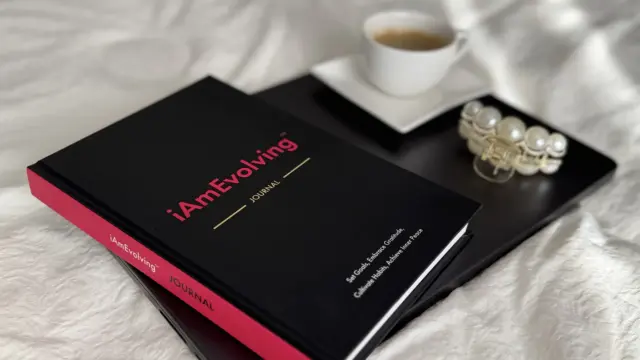
The iAmEvolving Journal was designed around this principle. It is not a rigid template that demands perfection. It meets you where you are, whether that is full of clarity or completely falling apart. Because growth does not require having it together. Growth just requires being honest about where you are.
If you have been telling yourself that you will start journaling when things calm down, consider this: things may not calm down for a while. And that is exactly why starting now, imperfectly, matters. Journaling for women is not about having the right setup. It is about giving yourself permission to take up space on a page, even when the rest of your life feels like it belongs to someone else.
Based on the iAmEvolving framework, the most meaningful journaling sessions are often the messiest ones. The entries you write through exhaustion and tears tend to be the ones that show you the most about yourself. They are the ones you will reread six months later and think, “I was stronger than I knew.”
You Deserve Those Five Minutes
New motherhood asks you to give constantly. It asks for your body, your sleep, your patience, your attention, and your energy. It asks for all of it, every single day, without a break. And in the middle of that giving, it is easy to forget that you are allowed to keep something for yourself.
Five minutes of writing is not selfish. It is not a luxury. It is one of the simplest and most effective ways to stay connected to yourself during a season of life that can make you feel invisible. The pages will not judge you. They will not need anything from you. They will simply hold whatever you need to put down.
So start today. Not perfectly. Not with a plan. Just open a notebook, or a note on your phone, and write one honest sentence about how you are really doing. That is enough. That is more than enough. And if you would like a gratitude journal for women that also holds space for the hard days, the iAmEvolving Journal is built for exactly that kind of honest, no-pressure writing.
Start your daily practice of gratitude, goals, and growth.
Get the Journal →A gentle 7-day reset to help you slow down, feel steadier, and reconnect — in just 5–10 minutes a day.
Start the ResetA simple introduction to daily journaling — gratitude, goals, and habits made easy.
Learn the MethodFrequently Asked Questions
Is journaling good for new moms?
What should a new mom write about in a journal?
How do you find time to journal as a new mom?
Does journaling help with postpartum anxiety?