Mental Health Journaling for Men: Breaking the Stigma One Page at a Time

A mens journal for mental health is one of the most effective tools available for processing emotions, reducing stress, and building the kind of inner resilience that sustains a man through every season of life. Research from the University of Texas shows that expressive writing for just 15 to 20 minutes a day significantly reduces cortisol levels, improves immune function, and decreases symptoms of anxiety and depression. Yet most men never pick up a pen for this purpose, not because it would not help, but because no one ever told them it was an option.
Men are twice as likely to die by suicide as women, and three out of four suicide deaths in the United States are male. Depression in men is dramatically underdiagnosed because the symptoms often look different: irritability, anger, withdrawal, risk-taking, substance use. Traditional therapy remains underutilized, with only about 40 percent of men with mental health conditions seeking professional help. Journaling for mental health offers something different: a private, self-directed practice that meets men where they are, on their own terms, with no audience and no judgment.
Why Men Struggle to Talk About Mental Health
Before we look at how a mens journal for mental health works, it is worth understanding why so many men resist emotional expression in the first place. The resistance is rarely about weakness. It is about conditioning.
From a young age, most boys absorb a clear message: strong men do not cry, do not complain, and do not ask for help. This is not just anecdotal. The American Psychological Association’s 2018 guidelines on working with men and boys identified “traditional masculinity ideology” as a significant barrier to mental health care. The expectation to be stoic, self-reliant, and emotionally contained leads many men to suppress what they feel rather than process it.
That suppression comes at a real cost. Unprocessed emotions do not disappear. They show up as chronic tension, sleep problems, explosive anger, numbing through alcohol or overwork, relationship breakdowns, and in the worst cases, complete psychological collapse. The National Institute of Mental Health reports that men are far less likely than women to have received any mental health treatment in the past year, despite experiencing comparable rates of psychological distress.
The problem is not that men are incapable of emotional awareness. It is that most men were never given a framework for it. Journaling provides that framework.
Why a Mens Journal for Mental Health Works When Other Approaches Do Not
There is a reason journaling resonates with men who resist therapy, meditation groups, and emotional conversations. A journal has no expectations. It does not interrupt, offer unsolicited advice, or judge what you write. For a man who has spent decades learning to keep things inside, the page is the safest place to start letting things out.
Here is what makes a men’s mental health journal uniquely powerful:
- Complete privacy. No one reads your journal unless you choose to share it. There is no social risk, no vulnerability hangover, and no performance pressure.
- Self-directed pacing. You control the depth and speed. Write one sentence or five pages. Start with surface frustrations and move deeper over time.
- No emotional vocabulary required. Many men struggle to articulate emotions because they were never taught the language. Journaling builds that vocabulary gradually, at your own pace.
- Actionable and structured. Unlike venting to a friend or sitting with vague anxiety, journaling with prompts gives the process structure. That appeals to the part of most men that wants to solve, fix, or improve something.
- Evidence of progress. Flipping back through old entries and seeing how your thinking has shifted is concrete proof that the work is doing something. Men respond to measurable results.
This is not about becoming someone you are not. It is about building a practice that helps you see yourself more clearly and respond to life with more intention. Research from UCLA’s neuroscience lab found that the simple act of labeling an emotion in writing, what psychologists call “affect labeling,” reduces activity in the amygdala, the brain’s threat center. In other words, writing about what you feel literally calms your nervous system. You can read more about how journaling rewires your brain for a deeper look at the neuroscience behind this process.
The Science Behind Using a Mens Journal for Mental Health
The benefits of journaling for men’s mental health are not based on speculation. They are grounded in decades of peer-reviewed research.
Dr. James Pennebaker, a social psychologist at the University of Texas at Austin, conducted landmark studies in the 1980s and 1990s showing that people who wrote about traumatic or emotionally significant experiences for 15 to 20 minutes per day over four consecutive days showed measurable improvements in physical and psychological health. Participants had fewer doctor visits, lower blood pressure, improved immune markers, and reported less anxiety and depression. These effects were documented across gender, age, and cultural background.
More recent research has expanded on these findings:
- Cortisol reduction. A 2017 study in the journal Psychotherapy Research found that expressive writing significantly lowered cortisol levels in participants, with effects lasting well beyond the writing session itself.
- Emotional regulation. UCLA’s affect labeling research, led by Dr. Matthew Lieberman, demonstrated that putting feelings into words engages the prefrontal cortex and reduces amygdala reactivity. This means writing about anger, frustration, or sadness literally makes those emotions less intense.
- Cognitive processing. Journaling forces the brain to organize scattered thoughts into coherent narratives. This process, called “cognitive integration,” helps men make sense of experiences that feel confusing or overwhelming.
- Improved sleep. A 2018 study published in the Journal of Experimental Psychology found that spending five minutes before bed writing a to-do list or processing the day’s events helped participants fall asleep significantly faster than control groups.
- Reduced rumination. For men who tend to replay problems without resolution, journaling interrupts the rumination loop by externalizing thoughts. Once a worry is on paper, the brain stops cycling through it as aggressively.
The evidence is clear: a men’s mental health journal is not a soft practice. It is a neurologically effective tool for managing stress, processing difficult experiences, and building emotional resilience over time. For those dealing with anxiety or depression specifically, understanding how journaling helps anxiety and depression can provide additional context and motivation to begin.
Mental Health Journal Prompts Designed for Men
One of the biggest obstacles men face with journaling is the blank page. Staring at an empty notebook with no idea what to write is enough to make most people quit before they start. That is where targeted prompts become essential. The right prompt bypasses the resistance and gives your mind a specific entry point.
Here are prompts specifically designed for men working through mental health challenges:
Processing Stress and Pressure
- What is weighing on me most right now, and what part of it can I actually control?
- Where am I carrying tension in my body today? When did it start?
- What responsibility am I shouldering that is not actually mine to carry?
- If I could hand off one source of stress to someone I trust, what would it be?
Exploring Anger and Frustration
- What triggered my anger this week? Was the anger about this situation, or something deeper?
- What emotion might be hiding underneath my frustration right now?
- When was the last time I felt genuinely angry, and how did I handle it? Would I handle it differently today?
- What would I say to someone I trust if I could be completely honest about what is bothering me?
Building Self-Awareness
- What am I avoiding, and what would happen if I faced it directly?
- When do I feel most like myself? When do I feel the most disconnected from who I want to be?
- What pattern keeps showing up in my relationships, work, or habits that I want to change?
- What does strength actually look like to me, stripped of what I was taught it should look like?
Reconnecting with Purpose
- What mattered to me five years ago that I have stopped paying attention to?
- If nobody else’s opinion counted, what would I change about my life tomorrow?
- What would my ideal day look like, not the productive version, the fulfilling version?
- What is one thing I am proud of that I never talk about?
These prompts work because they are direct, practical, and honest. They do not ask you to “explore your inner child” or “connect with your feminine energy.” They ask you to look at real situations in your life with more clarity and less avoidance. That is what journaling for emotional clarity actually looks like in practice.
Get more like this, every week
How to Build a Daily Mental Health Journaling Practice
Starting a journaling practice does not require an hour, a special notebook, or a perfectly quiet room. The men who sustain this habit long-term are the ones who keep it simple, consistent, and low-pressure. Here is a straightforward approach that works, even if you have never journaled before.
Start with Five Minutes
Set a timer for five minutes and write without stopping. Do not edit, do not judge, do not worry about grammar or coherence. The goal is not to produce something worth reading. The goal is to externalize whatever is in your head. Five minutes is enough to break the seal. You can always write longer once the habit is established. If you are completely new to the practice, a step-by-step guide on journaling for beginners can help you build confidence in those first sessions.
Choose a Consistent Time
Morning journaling works well for setting intention and clearing mental clutter before the day begins. Evening journaling is better for processing what happened, releasing the day’s tension, and improving sleep. Choose the time that fits your natural rhythm and attach the habit to something you already do, like drinking your morning coffee or settling in after the house gets quiet at night.
Use a Physical Journal
While digital tools have their place, writing by hand activates different neural pathways than typing. The slower pace of handwriting forces your brain to process thoughts more deliberately, which deepens the emotional and cognitive benefits. A structured journal with built-in prompts can also remove the friction of deciding what to write. If you are looking for something designed with this kind of intention, check out our guide to journaling for men.
Write Honestly, Even When It Is Uncomfortable
The entries that feel hardest to write are usually the most important. If you find yourself resisting a particular prompt or topic, that resistance is information. It is pointing you toward something that needs attention. You do not have to resolve anything in a single session. You just have to be willing to name what is real.
Do Not Aim for Perfection
Some days you will write two sentences. Some days you will fill three pages. Both are valid. The point is showing up, not performing. If you skip a day, you do not start over. You just pick up the pen again tomorrow.
Journaling and Therapy: Partners, Not Competitors
One important clarification: a mens journal for mental health is not a replacement for professional support. If you are dealing with severe depression, suicidal thoughts, trauma, or any condition that is significantly impacting your ability to function, a therapist is the right first step. Journaling does not replace that kind of care.
What journaling does is complement therapy in powerful ways:
- Between sessions. Journaling helps you process insights from therapy sessions and track patterns between appointments. Many therapists actively encourage clients to journal between visits.
- Before sessions. Walking into a therapy appointment with a clear sense of what you want to discuss, because you have been writing about it all week, makes those sessions dramatically more productive.
- After therapy ends. When therapy has given you the tools, journaling becomes the ongoing practice that keeps those tools sharp. It is the maintenance layer of mental health care.
- Instead of nothing. For men who are not ready for therapy, or who do not have access to it, journaling is a meaningful first step that builds emotional awareness on its own terms. It is infinitely better than doing nothing at all.
The relationship between journaling and therapy is not either-or. It is both-and. Many men find that journaling is the bridge that eventually makes them comfortable enough to seek professional support, because they have already started doing the inner work on their own.
Pushing Through the Initial Discomfort
Here is the honest truth about starting a mental health journaling practice as a man: the first few sessions will probably feel awkward. You might sit there with the pen in your hand, feeling foolish, wondering what you are supposed to write and whether any of this actually matters.
That discomfort is normal, and it is temporary. It is the feeling of doing something your conditioning told you not to do. Every man who has built a consistent journaling habit has pushed through that same resistance.
A few things that help:
- Treat it like training. You would not skip the gym because the first workout was hard. Journaling is mental fitness. The early sessions are supposed to feel unfamiliar.
- Nobody has to know. If having a journal feels strange, keep it in a drawer, in your car, or on your phone. There is no obligation to tell anyone about your practice.
- Start with facts, not feelings. If writing about emotions feels like too much, start with a simple log: what happened today, what went well, what did not. The emotional layer will emerge naturally over time.
- Remember why you started. You picked up that journal because something in your life is not working the way you want it to. The pen in your hand is evidence that you are doing something about it.
The men who benefit most from journaling are not the ones who find it easy. They are the ones who show up even when it feels pointless, and then one day realize that the fog has lifted, the anger has softened, and they are sleeping better than they have in years.
Conclusion
A mens journal for mental health is not about becoming someone you are not. It is about finally giving yourself a place to be honest about who you are, what you carry, and what you need. That honesty, practiced consistently, changes everything: your stress levels, your relationships, your sleep, your capacity to handle pressure without breaking down.
The stigma around men and emotional expression is real, but it is not permanent. Every man who picks up a journal and writes something honest chips away at that stigma, not just for himself, but for the men around him. You do not need to announce it. You just need to start.
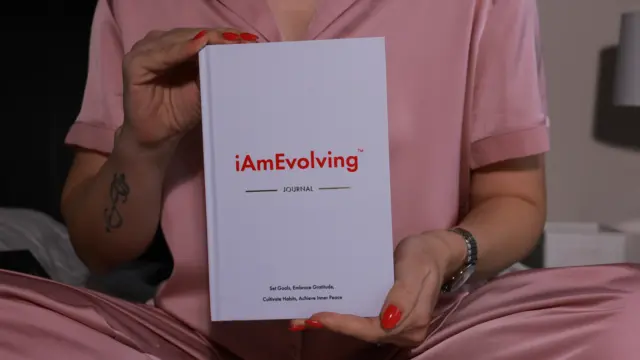
If you are ready to build a journaling practice that supports your mental health with structure, intention, and purpose, explore our complete journaling guide to find the approach that fits your life. The iAmEvolving Journal was designed with this kind of practice in mind: daily prompts for reflection, gratitude, goal-setting, and personal growth, all in a format that respects your time and meets you where you are.
Start your daily practice of gratitude, goals, and growth.
Get the Journal →A gentle 7-day reset to help you slow down, feel steadier, and reconnect — in just 5–10 minutes a day.
Start the ResetA simple introduction to daily journaling — gratitude, goals, and habits made easy.
Learn the MethodFrequently Asked Questions
Is journaling really effective for men’s mental health?
How long should men journal each day for mental health benefits?
What should men write about in a mental health journal?
Can journaling replace therapy for men?
How do I start journaling if I have never done it before?