Self-Discovery Through Journaling: Finding Who You Really Are

A self discovery journal is one of the most honest mirrors you will ever hold up to yourself. Unlike a diary that records what happened to you, a self-discovery journal asks you to look inward and engage with the questions you rarely sit still long enough to consider, questions about your values, your fears, the beliefs you carry without choosing them, and the person you are becoming when no one is watching. Research in expressive writing suggests that structured self-reflection can reduce emotional distress and increase self-understanding in as few as four sessions of 15 to 20 minutes each.
Most people spend years building a life around expectations they never examined. They move through routines, relationships, and roles on autopilot, rarely pausing to ask whether any of it reflects who they actually are. That is not a personal failing — it is what happens when life keeps moving and you never get handed the right questions. This guide walks you through the practice of using a journal to find yourself, not in a single dramatic moment, but through honest, patient, ongoing reflection. If you are new to the practice, the journaling guide is a helpful place to understand how journaling fits into a larger growth framework.
Why Most People Do Not Actually Know Themselves
This is not a judgment. It is a pattern. Most people carry an image of who they are that was assembled in childhood and reinforced by environment, culture, family, and habit. You might identify as “the responsible one” or “the person who keeps it together” without ever questioning where those labels came from or whether they still fit. Social conditioning teaches you to perform identity rather than explore it.
The deeper issue is that daily life does not require self-knowledge. You can hold a job, maintain friendships, and keep busy without ever examining your inner landscape. Autopilot is efficient. It gets you through the week. But efficiency is not the same as alignment, and staying busy is not the same as being present. When people finally do slow down, during a loss, a transition, a quiet Sunday afternoon that catches them off guard, they often feel an unsettling distance from themselves. That distance did not appear overnight. It was built one unexamined day at a time.
This is where the gap between knowing yourself and thinking you know yourself becomes clear. Thinking you know yourself means having answers ready. Actually knowing yourself means being willing to sit with questions that do not have tidy answers. Understanding your own self awareness and identity is the foundation for everything that follows in personal growth.
What a Self Discovery Journal Does Differently
A standard journal might ask: “What happened today?” A self discovery journal asks: “Why did that bother me?” or “What am I avoiding right now?” The difference matters. Writing about events keeps you at the surface. Writing about your interior world — your reactions, assumptions, desires, and resistance, takes you underneath the surface where the real material lives.
Self-discovery journaling is not just venting. It is directed reflection. The prompts and questions are designed to challenge automatic thinking and reveal patterns you cannot see from inside your daily routine. Think of it as asking yourself the questions a wise, patient friend would ask, the ones that make you pause and say, “I have never thought about that before.”
This type of journaling works because it interrupts the default narrative. Most of us run an internal story about who we are, and that story rarely gets updated. A self discovery journal creates a space where you can question the story, add chapters that were missing, and cross out lines that no longer ring true. It is less about finding a final answer and more about developing an ongoing, honest relationship with yourself.
Journaling About Your Day vs. Journaling About Your Identity
Both forms of journaling are valuable, but they serve different purposes. Daily journaling helps you process events, track moods, and notice what is happening around you. Identity journaling goes deeper. It asks who is experiencing those events, and why they respond the way they do.
Here is a simple way to understand the difference. If you write, “I got frustrated in the meeting today,” that is event journaling. If you write, “I got frustrated in the meeting today, and I think it is because I have this belief that my ideas do not matter unless someone else validates them first”, that is self-discovery. The first sentence tells you what happened. The second sentence tells you something about who you are and what is driving your reactions beneath the surface.
Identity journaling tends to be uncomfortable at times. It requires you to look at things like fear, shame, desire, and contradiction. But that discomfort is the signal that you are moving past the surface. Practicing reflective journaling trains you to observe your own inner landscape without rushing to fix or judge what you find there.
Get more like this, every week
Powerful Self Discovery Journal Prompts to Start With
The right question can unlock more insight than ten pages of free-writing. Below are 20 prompts organized by theme, each one designed to take you below the surface. Do not rush through them. Sit with one prompt per session and write until you feel something shift, even if that shift is small.
Values and What Matters Most
- What would I fight for, even if no one agreed with me?
- When I feel most at peace, what am I usually doing or who am I with?
- Which of my daily choices actually reflect my values, and which ones contradict them?
- If I could only teach my future child three things about how to live, what would they be?
Identity and Self-Perception
- How do I describe myself when no one else is around to hear it?
- What role do I play most often in relationships, and do I actually want that role?
- Which parts of my personality were shaped by my family, and which ones did I choose?
- If I stopped trying to impress anyone, how would my life look different?
Patterns and Recurring Behaviors
- What situation keeps showing up in my life, and what is it trying to teach me?
- When I am stressed, what is my first instinct, and does it actually help?
- What is a habit I keep saying I will change but never do? What makes it hard to let go of?
- Where in my life am I repeating a pattern from my childhood?
Desires and Hidden Dreams
- What would I do with my life if money and approval were irrelevant?
- What is something I secretly want but feel embarrassed to admit?
- When I imagine my ideal life five years from now, what surprises me about the picture?
- What have I given up on that I still think about?
Fears and Resistance
- What am I most afraid people will find out about me?
- What would I do this week if I knew I could not fail?
- What is a truth I have been avoiding, and what would change if I accepted it?
- Where in my life am I choosing comfort over growth, and why?
If you want an even deeper collection of prompts specifically designed for this kind of work, the companion guide on journaling prompts for self discovery offers a full set organized by emotional theme and intention.
How to Use Journaling to Uncover Hidden Beliefs and Patterns
Beliefs operate like invisible software. They shape how you interpret every experience, but you rarely see them directly. You do not think, “I believe I am not good enough.” You think, “Of course they did not call me back.” The belief is embedded in the reaction, not stated out loud.
Journaling helps you reverse-engineer those beliefs. The process is straightforward: write about a moment that triggered a strong emotion. Then keep asking “why” until you hit something that surprises you. For example, you might start with “I felt angry when my partner forgot our plans.” Then ask: why did that hurt so much? “Because I felt unimportant.” Why does feeling unimportant affect me this strongly? “Because I grew up in a house where I was always the afterthought.” Now you are looking at the belief, not just the event.
This is not therapy, but it is therapeutic. You are building the skill of pattern recognition, and that skill compounds over time. After a few weeks of this kind of writing, you will start catching beliefs in real time, not just on the page. You will notice yourself reacting from an old story and have the awareness to choose a different response. The practice of journaling for emotional clarity uses a similar approach to help you see what is really driving your emotional responses.
Here are three techniques that work well for uncovering hidden beliefs through journaling:
- The “Five Whys” method: Start with an emotion or reaction and ask “why” five times in a row, writing your answer each time. The first few answers will be obvious. The last one usually carries the insight.
- Complete the sentence: Write “I believe I am…” or “I believe the world is…” and let your pen finish without editing. Do this ten times quickly. The repetitions after the fifth round tend to reveal what is actually running beneath your conscious thoughts.
- Contrast mapping: Write about who you present to the world in one column and who you are in private in another. The gaps between those two versions are where your most important growth work lives.
What Self-Discovery Actually Looks Like in Practice
Self-discovery is not a lightning bolt. It does not arrive in a single dramatic session where everything clicks. It is more like adjusting the focus on a camera, gradually, the image gets sharper, and you start noticing details you missed before.
In practice, it often looks like this: you journal for two weeks and feel like nothing is happening. Then one morning you write something that makes you stop mid-sentence because you realize you have been carrying a specific belief for decades without ever examining it. Or you look back at your entries from the past month and notice a word that keeps appearing. “enough,” or “safe,” or “alone”, and that repetition tells you something important about where your attention is focused.
From personal experience, some of the most meaningful insights I have had through journaling came not during the writing itself, but hours or days later, in the middle of a conversation or a quiet walk. The journal planted the seed. The understanding ripened on its own schedule. That is how real self-awareness works — it unfolds rather than announces itself. And when you look back over weeks and months of entries, the signs that you are growing become visible in ways they never would without a written record.
The important thing is to keep going, even when it feels like you are writing the same things over and over. Repetition in a journal is not failure — it is your subconscious telling you where the unfinished work is. The entries that bore you the least and unsettle you the most are usually the ones worth returning to.
Building a Self Discovery Journal Practice That Lasts
Sustainability matters more than intensity. A five-minute journaling practice you maintain for six months will take you further than a two-hour session you abandon after a week. The goal is not to write a masterpiece, it is to build a habit of honest self-inquiry.
Start with a simple structure. Choose one prompt from the list above, set a timer for ten to fifteen minutes, and write without stopping or editing. Do not worry about grammar, logic, or whether it “makes sense.” The messiest entries are often the most revealing because they bypass the part of your mind that wants to sound polished and together.
If you are not sure where to begin, starting with a guided format can make the first few weeks much easier. A resource like how to start journaling for beginners covers the practical side of getting started without overcomplicating the process.
Review your entries once a week. Read through what you wrote and highlight anything that surprises you, anything you repeated, and anything that stirred a strong feeling when you read it back. These highlights become the threads you pull on in future sessions. Over time, your journal stops being a collection of isolated entries and becomes a map of your inner terrain.
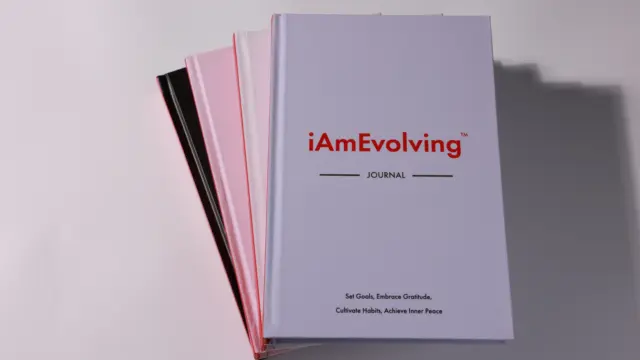
The iAmEvolving Journal was designed with this kind of practice in mind. Its daily structure includes dedicated space for reflection, awareness, and intentional growth, the three components that make self-discovery journaling effective over the long term. Rather than leaving you staring at a blank page, it provides enough structure to guide your writing without dictating what you should think or feel.
Conclusion
Knowing yourself is not a destination. It is an ongoing practice, one that requires honesty, patience, and the willingness to look at things you would rather avoid. A self discovery journal gives you the space to do that work on your own terms, at your own pace, without performing for anyone else. The questions it asks are not easy, but they are the ones that matter most.
You do not need to overhaul your life to begin. You need a journal, a few minutes of quiet, and one good question. Start there. Write honestly. Let the process work at its own pace. The person you discover on the other side of that practice is not someone new, it is someone you have been carrying all along, waiting to be recognized.
Start your daily practice of gratitude, goals, and growth.
Get the Journal →A gentle 7-day reset to help you slow down, feel steadier, and reconnect — in just 5–10 minutes a day.
Start the ResetA simple introduction to daily journaling — gratitude, goals, and habits made easy.
Learn the MethodFAQ: Self-Discovery Through Journaling
What is a self discovery journal?
How long does it take to see results from self-discovery journaling?
Do I need special prompts for self-discovery journaling, or can I free-write?
Can self-discovery journaling replace therapy?
How often should I journal for self-discovery?