Journaling for Women: Build a Practice That Honors You

Journaling for women is one of the most effective practices for building emotional clarity, reducing daily stress, and reconnecting with your own voice in a world that constantly pulls your attention outward. Research by psychologist James Pennebaker has consistently shown that expressive writing lowers cortisol levels, strengthens immune function, and improves emotional regulation. These benefits are especially significant for women navigating the compound demands of modern life. Whether you are managing a career, raising a family, healing from a difficult season, or simply trying to remember who you are beneath all the roles you play, a journal gives you a private space to process, plan, and grow on your own terms.
What makes journaling particularly powerful for women is not just the science behind it. It is the way it honors your inner complexity. Women are often expected to hold everything together while making it look effortless, and that expectation leaves very little room for honest self-reflection. A journaling practice changes that. It creates a daily anchor where you can be fully truthful about your emotions, your boundaries, your dreams, and your needs. This guide, part of the ultimate journaling guide, walks you through everything you need to build a practice that genuinely fits your life: from the types of journals available to the research behind why this works, along with prompts, routines, and practical guidance designed specifically for women.
Why Journaling for Women Carries Unique Power
Women process emotions differently than men — not better or worse, but with a complexity that benefits enormously from written reflection. Neuroimaging research shows that women tend to use both hemispheres of the brain when processing emotional experiences, which means feelings are often interwoven with language, memory, and relational context. Journaling taps directly into this wiring. When you write about a stressful day, you are not just venting. You are giving your brain the chance to organize scattered emotional signals into something you can actually understand and work with.
There is also the reality of what most women carry on any given day. The mental load of managing household logistics, professional responsibilities, relationships, and often the emotional needs of everyone around you is immense. A 2023 study published in the Journal of Women’s Health found that women report significantly higher levels of chronic stress than men, with caregiving burden cited as the strongest predictor. Journaling provides a structured outlet for that invisible labor: a place where you do not have to manage anyone else’s experience and can focus entirely on your own.
Beyond stress management, journaling helps women reclaim their identity. Psychologist Kristin Neff’s research on self-compassion shows that women are more likely than men to engage in harsh self-criticism, especially around appearance, achievement, and caregiving adequacy. Writing with intention, using prompts that guide you toward self-awareness rather than self-judgment, interrupts those patterns. Over time, your journal becomes a record of your growth, your resilience, and your capacity to handle far more than you give yourself credit for.
Types of Journals for Women: Finding the Right Fit
Not every journal serves the same purpose, and part of building a lasting practice is choosing the format that matches what you need most right now. Here is a breakdown of the most impactful types of journals for women, along with who they serve best.
Gratitude Journals
A gratitude journal for women focuses on recognizing the good that already exists in your life. This is not about toxic positivity or pretending things are fine when they are not. It is about training your brain to notice what is working alongside what is hard. Research from UC Davis found that people who journaled about gratitude for ten weeks reported feeling 25 percent happier and exercised 1.5 hours more per week than a control group. For women dealing with overwhelm or burnout, gratitude journaling creates a counterweight to the negativity bias that stress amplifies.
Self-Care Journals
A self-care journal is designed to help you track your emotional and physical needs, set boundaries, and build awareness around what fills and drains your energy. This type of journal is especially valuable for women who tend to put everyone else first and struggle to identify their own needs without guilt. Prompts in a self-care journal often focus on energy levels, rest, emotional patterns, and what brings you genuine joy versus what you do out of obligation.
Affirmation Journals
An affirmation journal for women combines structured positive statements with reflective writing. The purpose is not to paste over difficult emotions with feel-good phrases but to gradually reshape the inner dialogue that runs beneath your daily decisions. When you write “I trust my ability to handle whatever comes today” and then reflect on moments where that was true, you build neural pathways that make confidence and self-trust more accessible in real-time situations.
Daily Journals
A daily journal for women provides a consistent space to check in with yourself every single day. It can blend gratitude, intentions, reflections, and free-writing into one cohesive practice. This format works well for women who want a versatile journal that adapts to whatever they need on any given day. Some mornings you write goals, other mornings you process a difficult conversation, and some days you simply record three things you are grateful for.
Guided vs. Blank Journals
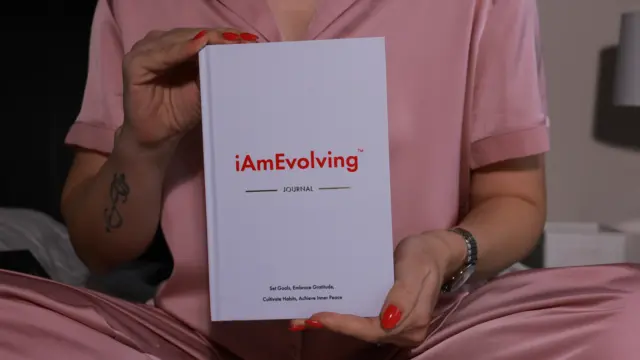
Guided journals include prompts, structure, and sometimes daily templates that tell you exactly where to start. Blank journals offer full freedom to write whatever comes to mind. Both have value, and the best choice depends on your personality and experience level. If you are new to journaling, a guided format removes the intimidation of a blank page and helps you build consistency faster. If you have been writing for years, a blank journal may feel more liberating. The iAmEvolving Journal combines both approaches, offering guided sections for gratitude, goals, habits, and reflection, along with open space for free-writing and personal exploration.
How Journaling Supports Women Through Life Transitions
One of the reasons journaling resonates so deeply with women is that it meets you wherever you are — and women’s lives tend to involve more identity-shifting transitions than most people acknowledge. Each of these transitions rewrites parts of who you are, and journaling provides the space to navigate that rewriting consciously rather than reactively.
Motherhood. Becoming a mother is one of the most profound identity shifts a woman can experience. The joy is real, and so is the grief: grief for your former self, your former body, your former freedom. Journaling during motherhood helps you hold both truths at the same time without guilt. It also helps you process the isolation that many new mothers feel but rarely say out loud.
Career shifts. Whether you are starting a new role, leaving a toxic workplace, launching a business, or navigating a layoff, career transitions test your sense of identity and worth. Women in particular often tie their value to productivity and external validation. Journaling creates a space to separate who you are from what you do, and to make decisions from clarity rather than fear.
Relationship changes. Divorce, breakups, setting new boundaries with family, or deepening a relationship. Each of these requires you to know what you actually want and need. Journaling for emotional clarity helps you untangle your feelings from other people’s expectations so you can make choices that are genuinely yours.
Grief and loss. Whether you are mourning a person, a relationship, a version of yourself, or a future that will not happen, grief needs somewhere to go. Writing does not fix loss, but it gives grief a container: a place where it can exist without consuming you. Studies on bereavement and expressive writing show that women who journal during grief report lower levels of depression and a stronger sense of meaning-making over time.
Identity evolution. Sometimes the transition is not a single event but a slow realization that you have outgrown the life you built. You feel restless, dissatisfied, or disconnected from the things that used to matter. Journaling helps you name what is shifting and gives you permission to evolve without needing to justify it to anyone. Self-discovery prompts are especially effective during these seasons because they guide you to ask questions you may have been avoiding.
Get more like this, every week
The Science Behind Journaling and Women’s Mental Health
The evidence supporting journaling as a mental health tool is substantial and growing. Here are the key findings that are most relevant to women’s well-being.
Stress reduction. James Pennebaker’s foundational research at the University of Texas demonstrated that writing about emotionally significant experiences for 15 to 20 minutes over three to four days leads to measurable improvements in physical health, immune function, and psychological well-being. Subsequent studies have replicated these findings across diverse populations, with women consistently showing strong responsiveness to expressive writing interventions.
Emotional regulation. A 2017 study published in Psychotherapy Research found that affect labeling (the act of putting feelings into words) reduces amygdala activation, which is the brain’s threat response center. For women who tend to carry emotional stress in the body (tension headaches, digestive issues, insomnia), journaling offers a direct pathway to reducing that physiological burden by processing emotions before they accumulate.
Self-compassion. Kristin Neff’s research at the University of Texas at Austin has shown that self-compassion writing exercises (where you write to yourself as you would to a close friend) reduce anxiety, depression, and rumination. Women, who are statistically more prone to self-critical thinking patterns, benefit significantly from this practice. When you write “I am doing the best I can with what I have” and genuinely engage with that statement, you are rewiring the default inner critic that so many women carry.
Hormonal well-being. Emerging research suggests that journaling can support women through hormonal fluctuations — from menstrual cycles to perimenopause and menopause. While journaling does not change hormone levels directly, it helps women track patterns, recognize triggers, and respond to mood shifts with awareness rather than reactivity. A simple practice of noting your energy, mood, and physical sensations daily can reveal patterns that were previously invisible, allowing you to plan your life around your biology rather than against it.
Trauma processing. For women who have experienced trauma (which includes a significant percentage of the female population), journaling provides a low-barrier entry point to processing difficult experiences. While it is not a replacement for therapy, expressive writing has been shown to reduce PTSD symptoms and improve emotional recovery when used alongside professional support.
Building a Journaling Routine That Fits Your Actual Life
The biggest reason women abandon journaling is not that they do not value it. It is that they set up a practice that requires more time, energy, or perfection than their real life allows. The most sustainable journaling routine is one that meets you where you are, not where you think you should be.
Here is how to build a practice that actually lasts.
Start with five minutes. You do not need an hour. You do not need a beautiful setup with candles and tea (though that is lovely when it happens). Five minutes of honest writing is worth more than thirty minutes of polished journaling that you dread. If five minutes feels like too much on some days, write one sentence. The point is to keep the habit alive, not to produce content.
Anchor it to something you already do. The most effective way to build a new habit is to attach it to an existing one. Write while your coffee brews. Journal during your child’s nap time. Reflect for five minutes before you turn off the light at night. A morning journaling routine works beautifully for some women, but it is not the only option. Find the time that is already naturally available in your day.
Let go of perfection. Your journal does not need to be grammatically correct, insightful, or even legible. It needs to be honest. Some of the most transformative journal entries are messy, angry, confused, or repetitive, because those are the entries where real processing happens. The moment you start editing yourself for an imaginary audience, you lose the therapeutic benefit.
Use prompts when you feel stuck. Blank-page paralysis is real, especially on days when your brain is already overloaded. Having a set of prompts ready removes the decision fatigue from your practice. Keep a list of five to ten questions that resonate with you, and rotate through them when you do not know what to write.
Give yourself permission to skip days. A missed day is not a failure. It is a normal part of being human with a busy life. The women who maintain a journaling practice for years are not the ones who never miss a day. They are the ones who come back after missing a day without beating themselves up about it. Consistency over perfection, always.
Journaling for Women: Prompts That Go Deeper
Good prompts do more than give you something to write about. They guide your attention toward areas of your inner life that often go unexamined: your worth, your boundaries, your desires, your relationship with yourself. Here are prompts organized by theme that speak directly to the experiences women navigate most often.
Self-Worth and Identity
- What is one thing I know to be true about myself that no one else’s opinion can change?
- When did I last feel fully like myself — what was I doing, and who was I with?
- What would I do differently if I stopped waiting for permission?
- What am I still carrying from someone else’s definition of who I should be?
Boundaries and Relationships
- Where in my life am I saying yes when I mean no, and what would change if I stopped?
- What does a healthy boundary look like in the relationship that drains me most?
- Who in my life makes me feel safe to be honest, and what makes that relationship different?
- What would I need to hear right now from someone who truly understands me?
Dreams and Future Vision
- If nothing were holding me back (no fear, no logistics, no judgment) — what would I build?
- What is one dream I have quietly shelved that deserves to be taken seriously again?
- Where do I want to be one year from today, and what is the smallest step I can take this week?
- What would the most courageous version of me do next?
Self-Care and Emotional Awareness
- What is my body trying to tell me that I have been ignoring?
- When was the last time I did something purely for my own enjoyment, not for productivity, not for someone else?
- What emotion am I avoiding right now, and what would happen if I let myself feel it fully?
- What does rest actually look like for me? Not what the internet says, but what my specific body and mind need?
If you want a broader collection of prompts for deeper reflection, explore these journaling prompts for self-discovery. They are designed to guide you into the questions that matter most.
How Journaling Builds Self-Trust and Inner Knowing
One of the least discussed but most transformative benefits of a consistent journaling practice is what it does to your relationship with yourself. Over time, journaling teaches you to trust your own voice, and for many women, that is a radical act.
Women are socialized from a young age to seek external validation. We are taught to check with others before making decisions, to prioritize other people’s comfort over our own instincts, and to second-guess the feelings that arise naturally in our bodies. Journaling reverses this pattern, not by fighting it, but by creating a daily practice where your own thoughts are the authority.
When you write down what you feel and then read it back, something shifts. You start to recognize patterns: patterns in what triggers you, what energizes you, what you avoid, and what you secretly want. Those patterns are data. They are evidence of a deeper wisdom that has always been running in the background but was never given space to be heard.
I have seen this happen repeatedly through the iAmEvolving community. Women who started journaling to manage stress discovered, within a few months, that they were making clearer decisions at work, setting boundaries they had been afraid to set, and feeling less anxious about the future. Not because the external circumstances changed, but because they had developed a relationship with their own inner knowing that made external noise less disorienting.
Self-trust does not come from a single breakthrough moment. It is built through the daily accumulation of honest reflection. Every time you write down what you really think, without censoring, without performing, without apologizing for it, you are telling yourself that your perspective matters. That practice compounds. And eventually, the woman who could not make a decision without polling five friends starts trusting her gut, because her journal has given her months of evidence that her gut was right all along.
Choosing a Journal That Honors Your Journey
The right journal is the one you will actually use. That might sound obvious, but many women buy beautiful journals and then feel too intimidated to write in them, or they start a journaling app and forget it exists within a week. Here is what to consider when choosing.
Your experience level. If you are just starting, a guided journal with daily prompts removes the friction of deciding what to write. If you have been journaling for a while, you might want a blend of structure and open space. For a comprehensive comparison of options, explore the best journals for women. It breaks down what works for different needs and personalities.
Your primary goal. Are you journaling for stress relief? Gratitude? Goal setting? Self-discovery? The best gratitude journals for women are specifically designed for daily thankfulness practice, while a self-care journal focuses on emotional awareness, boundaries, and personal needs. Knowing your primary intention helps you choose a format that reinforces it.
Your daily schedule. A journal with extensive daily templates may not work if you only have five minutes. A simpler format with three to five prompts per day might be more realistic. Conversely, if you have time for longer reflections, a journal that offers weekly reviews and deeper prompts will serve you better.
Physical vs. digital. Research consistently shows that handwriting activates more areas of the brain than typing, which enhances both memory and emotional processing. However, a digital journal that you actually use is better than a physical one that sits untouched on your nightstand. Choose the format that removes barriers rather than adding them.
The iAmEvolving Journal was designed with this flexibility in mind. It combines daily gratitude prompts, goal-setting sections, habit tracking, and open reflection space into one cohesive practice, so you do not need multiple journals to cover the different areas of your growth. It works as both a morning ritual and an evening wind-down, adapting to whatever your day requires.
Conclusion
Journaling for women is not about adding another task to an already full plate. It is about carving out a small, sacred space where you get to be the most important person in the room. A space where your thoughts, your feelings, and your growth are the only agenda. The research is clear that this practice reduces stress, builds emotional resilience, and strengthens your relationship with yourself. But beyond the science, there is something even more powerful happening every time you pick up a pen: you are saying, “My inner life matters enough to pay attention to.”
You do not need to write perfectly. You do not need to write every day. You just need to start, and keep coming back. Whether you begin with a gratitude list, a self-care check-in, or a free-write about whatever is weighing on your heart, every honest page brings you closer to the woman you are becoming. Start with the complete journaling guide if you want a broader roadmap, or simply open a blank page tomorrow morning and write what is true.
Start your daily practice of gratitude, goals, and growth.
Get the Journal →A gentle 7-day reset to help you slow down, feel steadier, and reconnect — in just 5–10 minutes a day.
Start the ResetA simple introduction to daily journaling — gratitude, goals, and habits made easy.
Learn the MethodFrequently Asked Questions
What makes journaling for women different from general journaling?
How long should a woman journal each day?
What should women write about in a journal?
Is a guided journal better than a blank journal for women?
Can journaling help women with anxiety and stress?
What is the best time of day for women to journal?